

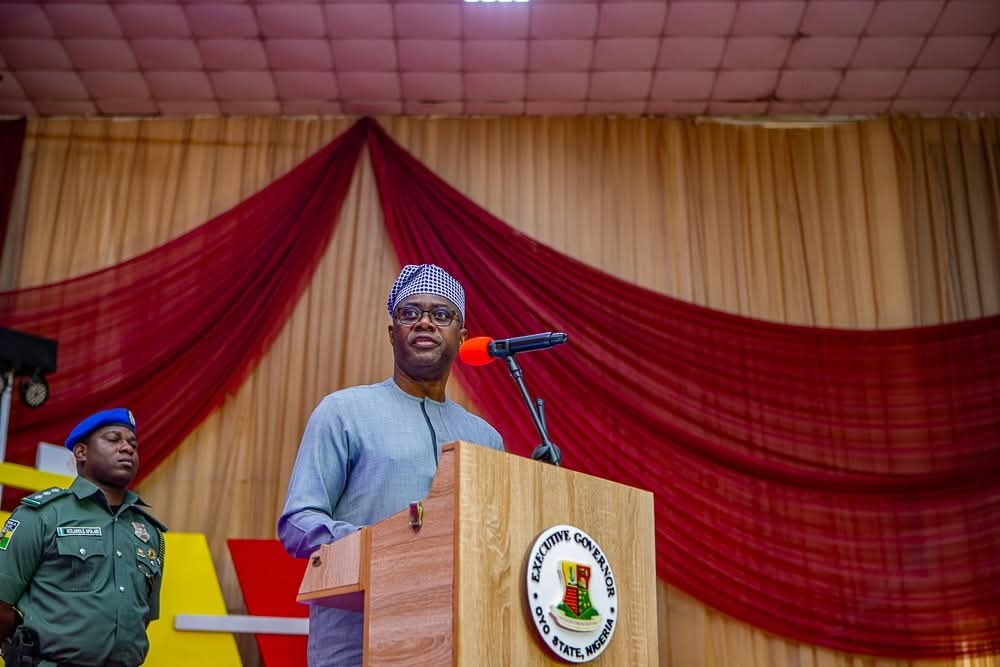

 Governor of Oyo State, Engineer Seyi Makinde, has reiterated his administration’s unwavering commitment to accountable governance, institutional strengthening and sustainable development, stressing that the progress recorded in the state must continue even after his exit from office.
The governor made this declaration on Wednesday during a public lecture and symposium held at the International Conference Centre, University of Ibadan, as part of activities marking the 50th anniversary of the creation of Oyo State.
Addressing participants drawn from different parts of the state and beyond, Makinde described the symposium as “a truly enlightening session,” noting that many of the issues raised were challenges his administration had either encountered or deliberately addressed in the course of governance.
Reflecting on the significance of the Oyo @ 50 celebrations, the governor said the anniversary was fundamentally about the people, their communities and their shared heritage, rather than government alone.
“They came out to celebrate their communities and their heritage. Perhaps the next celebration will be when I turn sixty. By that time, I will no longer be the Governor,” he remarked.
Makinde used the occasion to trace the origin of his administration’s development roadmap, explaining that it was conceived to rebuild public trust and institutionalise accountability in governance.
“Initially, I was preparing a roadmap to serve the people of our state. At the time, I did not anticipate that I would need to release it before the election, nor did I expect to openly invite the public to hold me accountable to it,” the governor said.
He recalled his experience during the 2015 governorship election, when many voters repeatedly told him, “your time is 2019,” an encounter that he said shaped his approach to leadership and public engagement.
“So, when I began campaigning again for 2019, people asked, ‘Can we trust you?’ At that point, I decided to put the roadmap together, release it publicly, and ask the people to hold me accountable on the basis of that document,” Makinde explained.
According to him, the first Roadmap for Accelerated Development, which covered the period between 2019 and 2023, was faithfully implemented by his administration and served as a foundation for future planning.
He added that the achievements recorded under the first roadmap informed the development of a second roadmap for Sustainable Development spanning 2023 to 2027.
“In that document, we reviewed the first roadmap and reported back to the people. We found that we had achieved over 75 per cent of the commitments we made,” the governor disclosed.
Makinde further revealed that work had already commenced on a third roadmap that would outline development priorities for Oyo State from 2027 and beyond, with a long-term outlook of 50 years.
“Once completed, it will be circulated publicly. Whenever the people ask for a roadmap, I am ready to present one and to be held accountable for it,” he assured.
Emphasising the central role of public trust in governance, Makinde said leaders must remain responsive to the aspirations and expectations of the people.
“One thing I have learnt is that you cannot take the people for granted. They want continuity; they do not want progress to stop,” he said, adding that the massive turnout at the Oyo @ 50 carnival sent a clear message: “We hope the music will continue.”
The governor also underscored the importance of strong institutions as pillars of democratic governance, noting that decisive leadership must be supported by enduring structures.
“Yes, we want strong and decisive leadership—leaders who can take difficult decisions and stand by them. But we also want leadership that is supported by strong institutions,” he stated.
Makinde listed several institutions established by his administration to promote good governance and accountability, including the State Anti-Corruption Agency, the Rule of Law Agency and the Anti–Land Grabbing Agency.
He, however, singled out the State Mobilisation Agency for Socio-Economic Development as particularly dear to him.
“Among all the institutions we have created so far, the one I cherish the most is the State Mobilisation Agency for Socio-Economic Development,” he said.
The governor further explained the rationale behind the establishment of the New Towns and Cities Development Authority, stressing the need to build urban spaces in Oyo State that meet global standards.
Using the University of Ibadan campus as an example, Makinde noted that modern cities must have integrated infrastructure systems.
“Here, you have a central power system, central water supply, fibre-optic communication infrastructure and, importantly, a central sewage system,” he said.
“A true first-world environment requires such systems as a standard,” the governor added, warning against reliance on septic tanks, which he said could contaminate groundwater.
“We have been fortunate not to experience a cholera outbreak, but that should not be our benchmark,” he cautioned.
Makinde said the mobilisation agency was designed to rally citizens around the task of expanding the state’s economy and driving socio-economic development, while also encouraging constructive criticism.
“I value honest feedback. I prefer to be told when I am wrong and to be challenged. That is the essence of constitutional democracy, even if it means progress can be slower,” he said.
The governor declared that Oyo State had deliberately moved away from patronage-based governance in favour of meritocracy.
“Decisions are no longer made on the basis of familiarity or influence,” he stated.
Citing the appointment of one of the symposium panellists, Makinde said the decision was based strictly on competence and merit, not lobbying or personal connections.
“That appointment was not the result of lobbying; it was based purely on merit. This is the system we are institutionalising—a merit-based system that puts the right people in the right positions,” the governor concluded.
Ends