

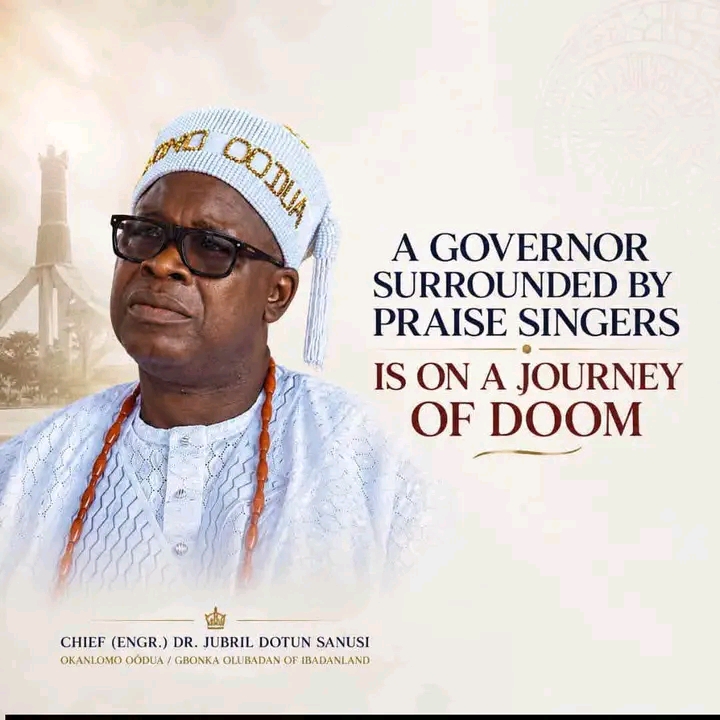
Sanusi Urges Respect for Traditional Institution, Cautions Against Politicising Oyo Royal Fathers
IBADAN — The Gbonka Olubadan, Engr. Jubril Dotun Sanusi, has called for mutual respect between the Oyo State Government and the traditional institution, urging political leaders to avoid actions or statements capable of intimidating traditional rulers or undermining their independence.
Sanusi, in a statement reacting to reports and a video circulating in which Oyo State Governor, Engr. Seyi Makinde, was quoted as warning that traditional rulers who engage in politics should be prepared to lose the privileges and respect accorded to the throne, said Nigeria’s traditional institution deserved “respect, not intimidation; engagement, not humiliation; partnership, not political threats.”
He stressed that no reasonable person would encourage traditional rulers to become partisan politicians, noting that Obas were fathers to all and should remain custodians of culture, peace, history and the collective conscience of their people.
However, Sanusi argued that political neutrality should not be interpreted as silence on issues affecting the welfare of the people.
He questioned whether traditional rulers should remain silent when their communities face insecurity, hunger, poor infrastructure, deteriorating schools and diminishing opportunities for young people.
According to him, there is a fundamental difference between partisan politics and the traditional ruler’s responsibility to speak on issues affecting his people.
“An Oba may not campaign for a political party. But an Oba has a moral responsibility to defend his people,” he said.
“A traditional ruler may not wear party uniforms. But he cannot be forbidden from speaking about hunger, insecurity, poverty, development and justice.”
Sanusi maintained that while a king should not become a political agent, neither should he be reduced to a figure who is unable to express legitimate concerns about the welfare of his subjects.
He further argued that the traditional institution predates many of the political structures operating in Nigeria today, stressing that while governments and political parties change, the traditional institution represents history, continuity and the cultural identity of the people.
The Gbonka Olubadan therefore urged political leaders to exercise caution when dealing with traditional rulers, particularly in the choice of language used in addressing disagreements between government and the royal institution.
He said any suggestion that a governor could withdraw respect from a traditional ruler should be treated seriously, arguing that respect for the institution should not depend on whether its views align with those of the government in power.
“Power is temporary. Office is temporary. Political authority is temporary. But institutions built upon centuries of history deserve humility and restraint from everyone privileged to occupy public office,” he said.
Sanusi also called for a relationship between government and traditional rulers based on partnership rather than hierarchy, noting that the two institutions have distinct but complementary responsibilities to the people.
According to him, a governor is an elected leader with constitutional responsibilities, while an Oba is a custodian of the history, culture and traditional identity of his people.
He said the strength of democratic leadership should be measured by the ability to accommodate criticism, divergent opinions and independent voices rather than by attempts to silence them.
Sanusi warned against redefining neutrality as submission, arguing that traditional rulers should not be regarded as politically neutral only when they support government programmes but labelled partisan when they question government policies.
He also recalled that political leaders routinely seek the support and legitimacy of traditional rulers during political campaigns, stressing that the dignity and independence of the traditional institution must equally be respected when the views of royal fathers become uncomfortable for those in power.
The traditional ruler emphasised that his position was not an attack on Governor Makinde but a defence of what he described as a fundamental principle.
“This is not an attack on Governor Seyi Makinde. It is a defence of principle,” he said, adding that political administrations would change while the traditional institution would remain.
Sanusi urged traditional rulers to remain non-partisan and avoid becoming instruments of political parties, but insisted that they should not be intimidated into silence when the security, welfare and dignity of their people are at stake.
He called for mutual respect, constitutional boundaries, political neutrality and dignity in the relationship between the government and the traditional institution.
“Kabiyesi is not above the law. The Governor is not above criticism. And no institution should be intimidated for standing with the people,” Sanusi said.
He added that the balance between political authority and traditional leadership was essential to the preservation of democratic values and the dignity of Oyo State.