

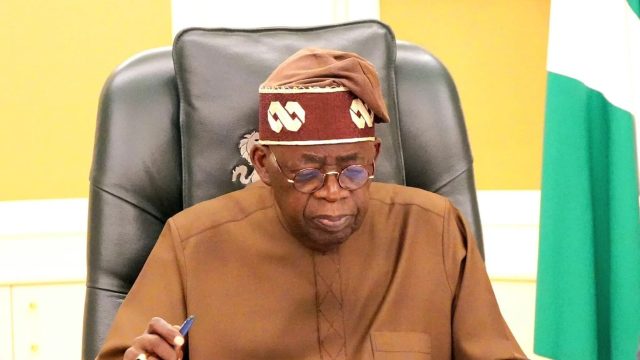
Nigeria’s mounting debt burden has come under heightened scrutiny as President Bola Tinubu seeks legislative approval for fresh external loans of $21.7 billion ($20.52 billion and €1.045 billion), amid rising debt refinancing and little to no savings to liquidate maturing obligations.
The latest request has revived concerns about the sustainability of the country’s borrowing strategy, including whether successive loans are financing productive investments capable of generating the revenue required to repay outstanding obligations or simply postponing the doomsday.
The Federal Government only remitted N374.63 billion, or 28.4 per cent of the N1.32 trillion budgeted for the Sinking Fund to Retire Maturing Loans between 2021 and 2025, Budget Implementation Reports (BIRs) data have shown.
The provisions were N200 billion in 2021, N270.71 billion in 2022, N247.73 billion in 2023, N223.66 billion in 2024 and N377.30 billion in 2025.
Only N600 million was released in 2021 and nothing in 2022 and 2023. In 2024, N265.86 billion was released, all in the fourth quarter. By September 2025, N108.17 billion had been released. The comprehensive report for last year is yet to be published.
In the past 10 years (2016 to 2025), the government budgeted N2.18 trillion for debt sinking fund financing. But as the gap between expenditure and revenue widened, the government diverted funds earmarked for mature debt retirement to other line items, exposing it to excessive refinancing.
The resultant vicious cycle, where the central government borrows to meet immediate financing needs, struggles to service or retire existing obligations and returns to the debt market to finance new deficits, is raising tension about the country’s future fiscal stability.
In principle, refinancing helps to manage cash flow, manage repayment schedules and replace expensive debt with cheaper facilities. But excessive reliance on new loans could potentially expose public finances to higher interest costs, external shocks, future repayment pressure and other refinancing risks.
In Nigeria, the government is not transparent about the proportion of mature debts that are refinanced. A large portion of monthly sovereign debt instrument issuances, whose purposes merely refer to budget support, is used to refinance existing loans, many believe.
In recent years, actual debt service spending outweighs budgeted sums, suggesting funds are moved from other uses to make up for the shortfall.
Nigeria’s public debt rose from N87.38 trillion in June 2023 to N166.79 trillion in June 2026, an increase of N79.41 trillion. The increase, however, may not be interpreted as the amount borrowed in cash by the Tinubu administration, as the recent sharp depreciation of the naira increased the nominal value of the external component of the debt.
The President argued that external financing is necessary to address the country’s infrastructure deficit and fund critical development projects.
In a letter read by Senate President Godswill Akpabio during plenary yesterday, Tinubu sought the “consideration and early approval” of the National Assembly for the proposed facilities under the Federal Government’s 2026–2027 Supplementary External Borrowing Plan.
The proposed borrowing comprises $20,517,755,901 and €1,045,083,643. The funds are earmarked for projects covering power, transportation, healthcare, education, agriculture, water supply, security, employment generation and financial management reforms.
Tinubu said the projects had undergone technical and economic evaluations and were expected to support job creation, skills acquisition, entrepreneurship, poverty reduction and food security. Most, he added, would be implemented across the 36 states and the Federal Capital Territory.
“In light of the need for significant infrastructure investment in the country and the vast financial resources needed to address this gap, it has become essential to pursue prudent external borrowings to close the financing shortfall,” the President stated.
The Senate referred the request to its Committee on Local and Foreign Debts for scrutiny, with possible input from the Committees on Appropriations and Finance. The proposal had not received final Senate approval as of yesterday.
THE immediate question is whether the proposed facilities will create sufficient economic and fiscal returns to justify their cost, and whether the government can meet the associated repayment obligations without further constraining public expenditure.
The government has been stretched to make up for the rising deficits, partly caused by the continued reliance on revenue from crude and inability to broaden the tax base. The 2024 fiscal deficit stood at N13.51 trillion, according to the figures cited in the borrowing debate. The gap between government revenue and expenditure continues to place pressure on public finances, while debt-service obligations compete with allocations for infrastructure and essential services.
The challenge, therefore, extends beyond the size of the proposed loans. It concerns the terms of the facilities, the projects they will finance, the pace at which they will be disbursed, the returns expected from them and the revenue available to repay them.
Earlier approvals raise questions about cumulative exposure. The latest request has also raised questions about its relationship with borrowing plans previously approved by the National Assembly.
After reading the President’s letter, Akpabio observed that elements of the proposal had featured in earlier government borrowing and budgetary arrangements, although he expressed uncertainty about the precise period covered by previous approvals.
“The borrowing plan is attached, but of course, this was even earlier approved in our budget, and also the external borrowing plan was approved as far back as 2025 to 2027, I think to 2028 or thereabouts,” he said.
He said the Senate Committee on Local and Foreign Debts, chaired by Haruna Manu, would examine the request and consult other relevant committees where necessary.
History of loan requests
THE 10th Senate has considered several substantial borrowing proposals, including an external borrowing plan of $7.8 billion and €100 million for infrastructure and other development projects.
Other facilities and proposals included a $5.8 billion loan request covering power, transportation, healthcare, education, agriculture and water supply; a $1.5 billion World Bank facility for budget financing and economic reforms and a $1.3 billion African Development Bank facility for agricultural development and food security.
The National Assembly also considered a $2.2 billion external borrowing request to finance the 2024 budget deficit and other government projects, alongside a $1.5 billion World Bank loan for economic stabilisation and development support. A separate N500 billion domestic borrowing plan was proposed to finance the 2023 supplementary budget and other obligations.
Tinubu had pursued borrowing proposals inherited from the previous administration, alongside new facilities under subsequent budgets.
On November 28, 2023, he asked the Senate to authorise external borrowing of $8.699 billion and €100 million under a 2022–2024 borrowing plan approved by the Federal Executive Council under late President Muhammadu Buhari in May 2023.
The proposed funds were intended for infrastructure, agriculture, healthcare, water supply, roads, security and other projects.
On November 19, 2024, the House of Representatives received a request for a resolution authorising approximately $2.209 billion, equivalent to N1.768 trillion at the budget exchange rate of N800 to the dollar. The request related to the external borrowing provision in the 2024 Appropriation Act, which provided for N7.829 trillion in new borrowing, comprising N6.061 trillion in domestic borrowing and N1.768 trillion in external borrowing.
In March 2026, the National Assembly considered two major financing facilities, including a $5 billion structured total-return-swap programme with First Abu Dhabi Bank, intended to support government financing, fiscal liquidity, infrastructure and the repayment of relatively expensive debt.
It also considered approximately $1.001 billion in UK Export Finance-backed lending arranged by Citibank for the rehabilitation of Lagos Port Complex and Tin Can Island Port Complex. The House of Representatives’ March 31, 2026 order paper outlined the amounts and proposed purposes of the facilities.
On April 23, 2026, Tinubu requested approval for an external loan of approximately $516 million for the Sokoto–Badagry Superhighway.
These transactions and proposals, some suggested, underline the need for a consolidated account of Nigeria’s borrowing commitments, showing which facilities have been approved, which have been signed, how much has been disbursed, what has been repaid and what remains outstanding.
MEANWHILE, former Vice President Atiku Abubakar has urged the National Assembly to suspend consideration of Tinubu’s request until the Federal Government publishes detailed information about the projects to be financed.
Atiku, the African Democratic Congress presidential candidate, argued that the proposal reinforced his earlier warning that the administration was preparing to obtain loans of up to $20 billion in connection with the Lagos-Calabar Coastal Highway project.
In a statement issued yesterday by Phrank Shaibu, Director of Strategic Communication of the ADC Presidential Campaign Council, the former vice president said lawmakers should demand full disclosure of the proposed projects, costs, locations, contractors, loan terms and repayment obligations before approving any loan.
“The National Assembly must not approve a single dollar until the President publishes every project, contract, cost, contractor, loan term and repayment obligation. No public money should be borrowed in the dark, and no lawmaker should sign a blank cheque against Nigeria’s future,” he said.
Previously, Atiku had raised concerns over reports that the President was preparing to borrow up to $20 billion for the coastal highway. He said Tinubu had neither confirmed nor denied the allegation nor published the accounts he had requested.
According to him, the subsequent request for $20.52 billion and €1.045 billion strengthened his concerns about the administration’s borrowing plans.
“The president has listed broad sectors but has not provided a project-by-project account of what this enormous borrowing will fund. Nigerians have not been given clear project details, costs, locations or contractors to scrutinise,” he said.
Atiku also questioned the timing of the proposal, arguing that Nigerians should not be saddled with substantial debt without adequate information about the projects and repayment terms.
He linked his concerns to the reported inland rerouting of the Lagos-Calabar Coastal Highway, alleging that the project could become a channel through which borrowed funds reach political campaigners and favoured contractors. These remain allegations by the opposition politician.
He warned that borrowing undertaken without the required constitutional, statutory and due-process requirements would face scrutiny if he assumed office.